
A Sieve Shaker is an essential laboratory instrument used for accurate particle size analysis of soil, aggregates, sand, cement, minerals, chemicals, and other granular materials. It automates the sieving process by providing uniform and controlled motion, ensuring consistent and repeatable test results compared to manual sieving.
In civil engineering laboratories, construction material testing facilities, research institutions, universities, and industrial quality control laboratories, a Sieve Shaker plays a critical role in determining particle size distribution. Accurate grading of materials helps engineers comply with quality standards and produce durable construction materials.
Whether you are testing aggregates for highways, soil for foundation design, or sand for concrete production, a high-quality Sieve Shaker significantly improves testing accuracy while reducing operator effort.
What is a Sieve Shaker?
A Sieve Shaker is a mechanical laboratory device designed to hold a stack of standard Test Sieves and produce controlled vibration and gyratory motion. This movement separates particles according to their size, allowing laboratories to perform accurate sieve analysis efficiently.
Unlike manual sieving, a Sieve Shaker provides uniform movement across the entire sieve surface, reducing human error and improving repeatability.
Working Principle of a Sieve Shaker
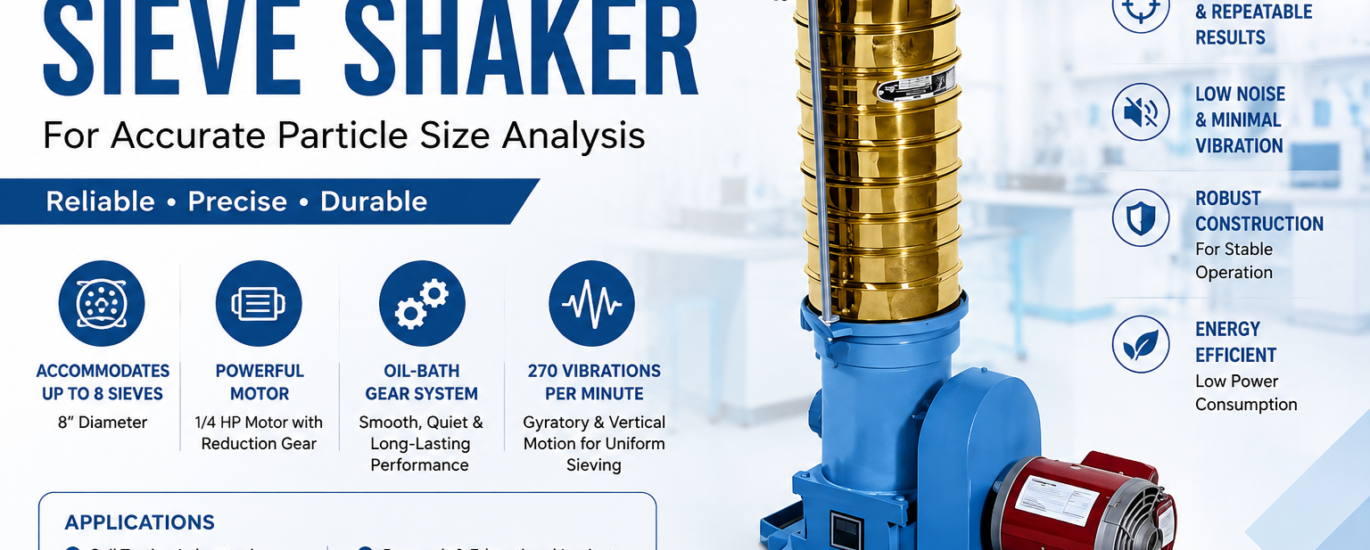
The Sieve Shaker operates using a ¼ HP motor connected to a precision reduction gear mechanism. Instead of rotating continuously, the sieve table remains inclined from the vertical axis while the direction of inclination gradually shifts in a clockwise direction.
During operation, the table performs both gyratory motion and vertical vibrations at approximately 270 vibrations per minute. This dual-action movement allows the sample to spread evenly across the sieve mesh, ensuring that every part of the sieve surface is effectively utilized.
The gear mechanism runs in an oil bath, which minimizes friction, reduces wear, lowers operating noise, and increases the service life of the equipment.
Key Features
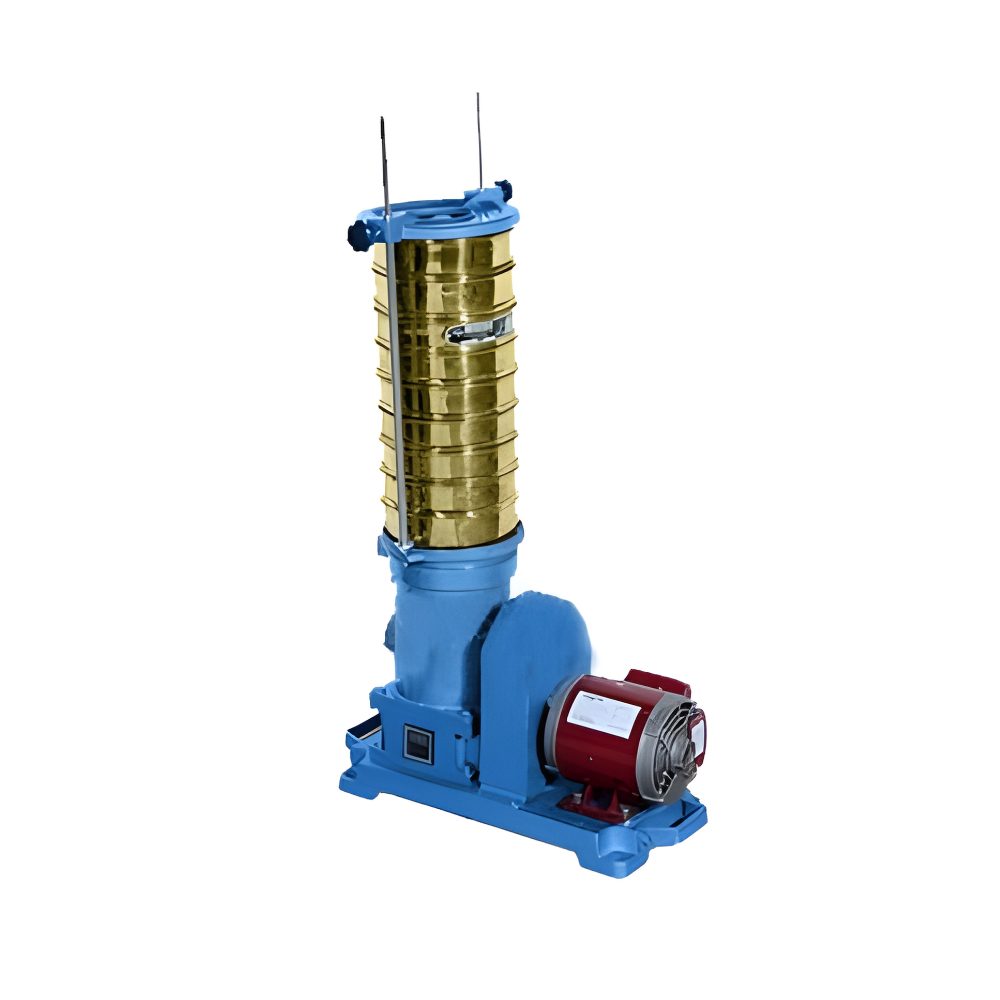
A high-quality Sieve Shaker from Sethi Instruments offers:
- Accommodates up to 8 standard 8-inch Test Sieves
- Powered by a reliable ¼ HP motor
- Precision reduction gear drive
- Progressive clockwise inclination mechanism
- Combined gyratory and vertical motion
- Approximately 270 vibrations per minute
- Oil-bath gear mechanism for smooth operation
- Strong and stable construction
- Low-noise operation
- Operates on 220V, 50Hz AC
- Supplied without Test Sieves, lid, and receiver
Benefits of Using a Sieve Shaker
Using a mechanical Sieve Shaker offers several advantages over manual sieving.
Accurate Particle Size Analysis
Uniform vibration ensures precise separation of particles, resulting in reliable grading results.
Repeatable Test Results
Controlled mechanical movement minimizes operator variation and provides consistent outcomes.
Better Utilization of Sieve Surface
The combined gyratory and vertical motion allows the entire sieve area to participate in particle separation.
Low Maintenance
The oil-immersed gear mechanism reduces wear, extends equipment life, and minimizes maintenance requirements.
Quiet and Stable Operation
Precision engineering helps reduce vibration and operating noise, making it suitable for laboratory environments.
Energy Efficient
The ¼ HP motor provides dependable performance with low power consumption.
Applications of Sieve Shaker
Sieve Shakers are widely used in:
- Soil testing laboratories
- Aggregate testing laboratories
- Cement and concrete testing
- Construction material testing
- Civil engineering laboratories
- Universities and research institutes
- Mining laboratories
- Industrial quality control
- Geotechnical laboratories
- Infrastructure projects
They are ideal for determining particle size distribution in materials such as soil, sand, gravel, crushed stone, cement, minerals, fertilizers, chemicals, and other granular products.
How to Choose the Right Sieve Shaker
When selecting a Sieve Shaker, consider:
- Number and size of Test Sieves required
- Type of material being tested
- Required testing standards (IS/ASTM)
- Motor capacity
- Vibration frequency
- Build quality and durability
- Ease of maintenance
- Availability of spare parts and support
Choosing the right equipment improves testing efficiency and ensures compliance with laboratory standards.
Maintenance Tips
To maintain long-term performance:
- Keep the machine clean after each use.
- Check the oil level periodically.
- Inspect moving parts for wear.
- Avoid overloading the sieve stack.
- Tighten fasteners regularly.
- Operate within the recommended voltage.
- Schedule routine preventive maintenance.
Proper maintenance helps ensure reliable performance and extends equipment life.
Why Choose Sethi Instruments?
Since 1985, Sethi Instruments has been manufacturing and supplying reliable laboratory testing equipment for civil engineering, construction, research laboratories, and quality control applications.
Our Sieve Shakers are designed for precision, durability, and long service life. Every unit is manufactured using quality materials and undergoes strict quality inspection before dispatch to ensure dependable performance.
In addition to Sieve Shakers, we also manufacture Test Sieves, Soil Testing Equipment, Aggregate Testing Equipment, Cement Testing Equipment, Concrete Testing Equipment, Bitumen Testing Equipment, and other laboratory instruments.
Frequently Asked Questions
What is a Sieve Shaker used for?
A Sieve Shaker is used to perform particle size analysis by separating materials according to their size using a stack of Test Sieves.
Which industries use Sieve Shakers?
Civil engineering, construction, mining, research laboratories, educational institutions, pharmaceuticals, and quality control laboratories.
How many sieves can this model accommodate?
This model is designed to hold up to eight 8-inch diameter Test Sieves.
What is the vibration frequency?
The machine provides approximately 270 vertical vibrations per minute.
Why is an oil-bath gear mechanism important?
It reduces friction, minimizes wear, ensures smooth operation, and increases the equipment’s service life.
Conclusion
A Sieve Shaker is a vital laboratory instrument for accurate particle size analysis and quality control across civil engineering and industrial applications. Its controlled gyratory motion, vertical vibration, and durable oil-bath gear mechanism ensure consistent and repeatable results while reducing operator effort. Whether used for soil, aggregates, cement, or other granular materials, investing in a precision-engineered Sieve Shaker improves laboratory efficiency and testing reliability. With decades of manufacturing experience since 1985, Sethi Instruments provides dependable Sieve Shakers that meet the demanding needs of laboratories, contractors, research institutions, and quality control professionals.
Explore Website:- https://sethiinstruments.com/
Visit Social Media
https://www.instagram.com/sethiinstruments
https://www.linkedin.com/in/sethiinstruments
https://www.youtube.com/@SethiInstruments
https://www.facebook.com/profile.php?id=61592602600713