

Riffle Sample Divider: Complete Guide to Accurate Aggregate Sampling, Working Principle & Laboratory Applications
Every laboratory test is only as reliable as the sample being tested. Even the most advanced testing equipment cannot produce dependable results if the sample does not accurately represent the bulk material. This is why laboratories involved in civil engineering, mining, construction, and material testing rely on the Riffle Sample Divider for precise and representative sample preparation.
Whether you are testing aggregates for road construction, analyzing cement quality, examining mineral samples, or preparing materials for laboratory analysis, a Riffle Sample Divider helps eliminate sampling errors by dividing bulk materials into equal and unbiased portions. This ensures that every test begins with a representative sample, leading to consistent and repeatable analytical results.
In this guide, we explore how a Riffle Sample Divider works, why it is an essential laboratory instrument, its applications, technical advantages, and how to select the right model for your testing requirements.
Why Representative Sampling Matters
Laboratory testing begins long before the actual analysis. The first and most critical step is collecting a sample that truly represents the original material. If the sample is uneven or biased, the test results can be inaccurate regardless of the quality of the laboratory equipment.
For industries such as construction, mining, geotechnical engineering, cement manufacturing, and quality control laboratories, representative sampling ensures reliable data for decision-making. A Riffle Sample Divider minimizes human error by splitting bulk materials into equal portions while preserving the original particle size distribution.
What is a Riffle Sample Divider?
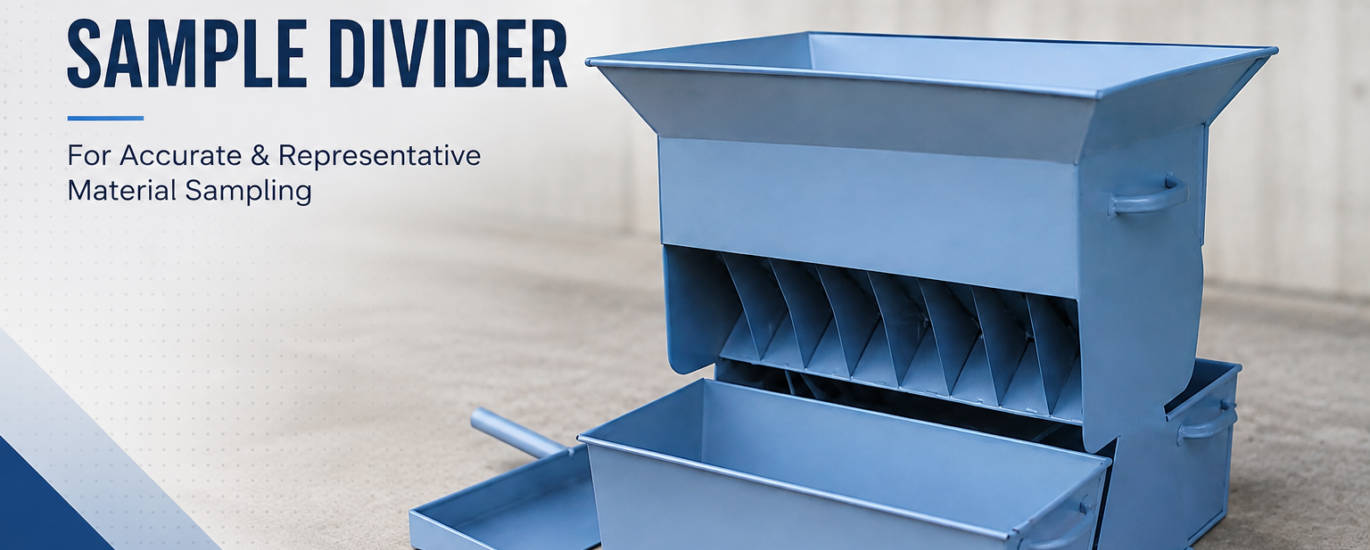
A Riffle Sample Divider is a laboratory instrument designed to divide large quantities of granular or powdered materials into two equal and representative samples. It is widely used for aggregates, ores, cement, sand, coal, pigments, refractory materials, chemicals, and other free-flowing materials.
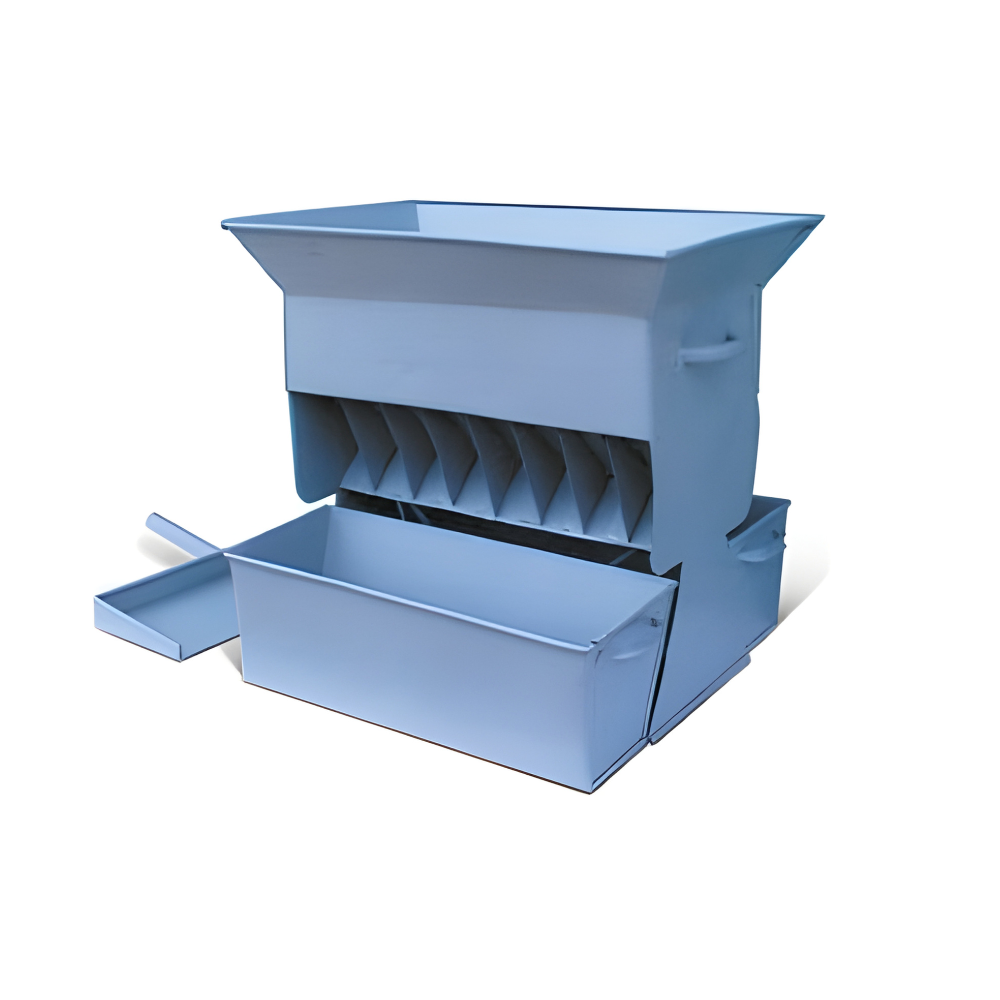
The equipment consists of a durable sheet-metal box mounted on sturdy legs and fitted with a series of accurately manufactured chutes. As the sample is poured into the hopper, the material flows through alternating chutes, which divide it evenly into two collection pans. This process produces unbiased samples suitable for laboratory testing and quality control.
How Does a Riffle Sample Divider Work?
The working principle of a Riffle Sample Divider is simple yet highly effective. The bulk sample is poured evenly into the feed hopper, where gravity directs the material through multiple equally sized chutes.
These chutes alternate the flow into two separate receiving pans, ensuring that each pan receives an equal proportion of the original sample. Because the material is divided mechanically rather than manually, the possibility of operator bias is significantly reduced.
The steep angle of the chutes allows materials to flow smoothly without clogging, even when handling fine powders or dense granular materials. This design helps maintain sample integrity and improves the consistency of laboratory testing.
Where is a Riffle Sample Divider Used?
The versatility of a Riffle Sample Divider makes it an indispensable tool across multiple industries.
Aggregate Testing Laboratories
It is used to prepare representative aggregate samples before conducting grading, impact, crushing, abrasion, and density tests.
Mining and Mineral Processing
Mining laboratories use the divider to obtain representative samples of ores and minerals for chemical and physical analysis.
Cement Industry
Manufacturers rely on accurate sample preparation to monitor raw materials and finished cement quality.
Soil and Geotechnical Laboratories
The divider is used to prepare soil samples for particle size analysis, moisture determination, and other geotechnical investigations.
Research and Educational Institutions
Universities and research laboratories use Riffle Sample Dividers for laboratory experiments involving powders and granular materials.
Choosing the Right Chute Size
Selecting the appropriate chute size is essential for achieving accurate sample division. The choice depends on the maximum particle size of the material being tested.
Common configurations include:
| Chute Size | Number of Chutes |
|---|---|
| 13 mm | 14 |
| 20 mm | 14 |
| 25 mm | 16 |
| 40 mm | 12 |
| 50 mm | 12 |
| 63 mm | 12 |
Using the correct chute size helps maintain uniform material flow and prevents particle segregation during sample preparation.
Technical Highlights
A quality Riffle Sample Divider offers several technical advantages that improve laboratory efficiency:
- Durable sheet-metal construction for long service life.
- Strong leg-mounted design for stability during operation.
- Precisely manufactured chutes for uniform material division.
- Steep chute angle for rapid and uninterrupted material flow.
- Equal distribution of materials into separate collection pans.
- Reliable performance for repetitive laboratory testing.
- Easy handling and minimal maintenance requirements.
Best Practices for Accurate Sample Preparation
To obtain the most reliable results, laboratories should follow a few simple practices:
- Mix the bulk material thoroughly before sampling.
- Ensure the divider is clean and free from previous residues.
- Pour the sample at a steady and uniform rate.
- Avoid overloading the hopper beyond its recommended capacity.
- Select a chute size appropriate for the particle size of the material.
- Repeat the division process if a smaller sample quantity is required.
Following these practices improves repeatability and reduces sampling errors.
Advantages Over Manual Sample Division
Many laboratories still divide samples manually, which often results in inconsistent and biased samples. A Riffle Sample Divider eliminates these problems by providing a standardized and repeatable sampling method.
Compared with manual methods, it offers:
- Higher sampling accuracy.
- Reduced operator influence.
- Better repeatability.
- Faster sample preparation.
- Lower material wastage.
- Improved laboratory productivity.
- Greater confidence in analytical results.
Maintenance Tips
Proper maintenance helps preserve accuracy and extend equipment life.
- Clean the divider after each use.
- Remove any trapped particles from the chutes.
- Store the equipment in a dry environment.
- Inspect the chutes periodically for wear or deformation.
- Avoid dropping heavy materials directly into the hopper.
- Handle the collection pans carefully to prevent damage.
Regular maintenance ensures consistent performance for years of laboratory use.
Why Choose Sethi Instruments?
Since 1985, Sethi Instruments has been manufacturing and supplying high-quality laboratory testing equipment for civil engineering, construction, mining, and industrial quality control applications.
Our Riffle Sample Dividers are manufactured using robust materials and precision engineering to deliver accurate, repeatable, and reliable sample preparation. Every unit undergoes strict quality inspection before dispatch, ensuring dependable performance in laboratories across India and international markets.
In addition to Riffle Sample Dividers, we offer Test Sieves, Sieve Shakers, Soil Testing Equipment, Aggregate Testing Equipment, Cement Testing Equipment, Concrete Testing Equipment, Bitumen Testing Equipment, and a complete range of laboratory testing instruments designed to meet modern industry requirements.
Frequently Asked Questions
What is a Riffle Sample Divider used for?
It is used to divide bulk granular or powdered materials into equal, representative samples for laboratory testing and quality control.
Which materials can be sampled?
It is suitable for aggregates, sand, cement, coal, ores, minerals, pigments, refractory materials, chemicals, and other free-flowing materials.
Why is representative sampling important?
Representative sampling ensures laboratory test results accurately reflect the properties of the original material, reducing errors and improving quality control.
How do I choose the correct chute size?
Choose a chute size that matches the maximum particle size of the material being tested to ensure smooth flow and accurate division.
Does the Riffle Sample Divider require electricity?
No. It operates manually using gravity, making it simple, reliable, and suitable for laboratory as well as field applications.
Conclusion
A Riffle Sample Divider is an essential tool for laboratories that require precise, unbiased, and repeatable sample preparation. By ensuring equal distribution of bulk materials, it improves the reliability of aggregate, soil, cement, mining, and industrial testing. Its robust construction, precision chute design, and ease of operation make it a valuable investment for quality control laboratories and material testing facilities. With decades of manufacturing expertise, Sethi Instruments provides dependable Riffle Sample Dividers designed to deliver consistent performance, long service life, and accurate sampling for a wide range of laboratory applications.
Explore Website:- https://sethiinstruments.com/
Visit Social Media
https://www.instagram.com/sethiinstruments
https://www.linkedin.com/in/sethiinstruments
https://www.youtube.com/@SethiInstruments
https://www.facebook.com/profile.php?id=61592602600713
